|
The output of the Loudspeaker is measured using calibrated SPL meter, and FFT software to measure the relative shift in level across the sweep
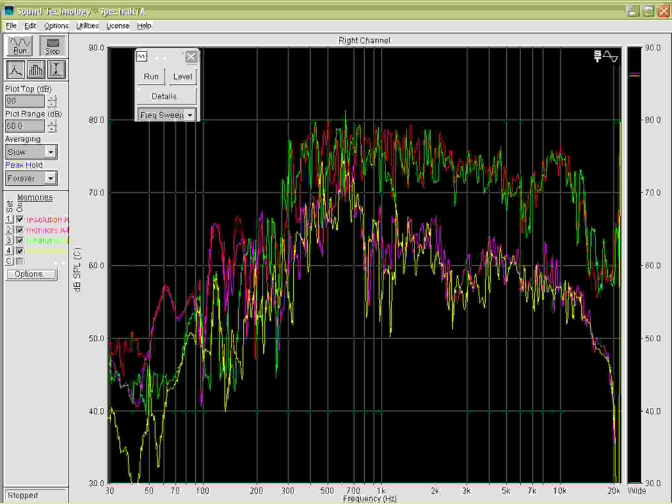
Above: Looking at the green/red (resolutiion) vs purple/yellow(celestion SL^) curces, you can see there are huge differences due to the loudspeakers chosen, so no wonder people say that loudspeakers are the weakest
part of any system.
Large chand sudden changes in F.R. are always due to resonances - parts of the cone or enclosure vibrating in
sypathy with the driving signal, and only stiffer, more vibration-absorbent technology will reduce this. most
manufacturers use electronic adjustment, multiple drive units, and careful measurement microphone placement to
achieve a basically flat F.R., but in an anechoic chamber test, is this fair as it eliminated most enclosure resonances that would bounce late off the missing walls?
Although you can 'tune' out the curve this way, you sacrifice clarity and realism, because you havent cured the
resonances, merely controlled the signals that excite them to a lower level - thus at the 'sorted' frequency, the user is no hearing as much signal as resonance - YUK!
tThe only proper way of developing loudspeakers thast work well, is to ignore F.R., and address the sources of
distortion. The resolution answers this need, and although the F.R is not flat, it is 'honest' - retaining all the detail
and level of your original signals.Why reviewers are interested in a flat F.R is a self-defeating notion, that
assumes thew flattest measurements are the best - in fact all the 'official' manufacturers F.R. published has been
impossible to reproduce that flat, and when challenged, they merely become evasive and vague about how and who tested them..
Not only are the resolution's F.R graphs accurate and honest, but dare to compare other loudspeakers in the same graph, so you can see the improvement, not how clever at manipulating data we are.
Honesty is the best loudspeaker!
|