|
The amplifier input/output ratio should be the same at LF and HF throughout the range. we can expect cheaper amps to roll off the bass below 50Hz as this would otherwise increase the chances of distortion.
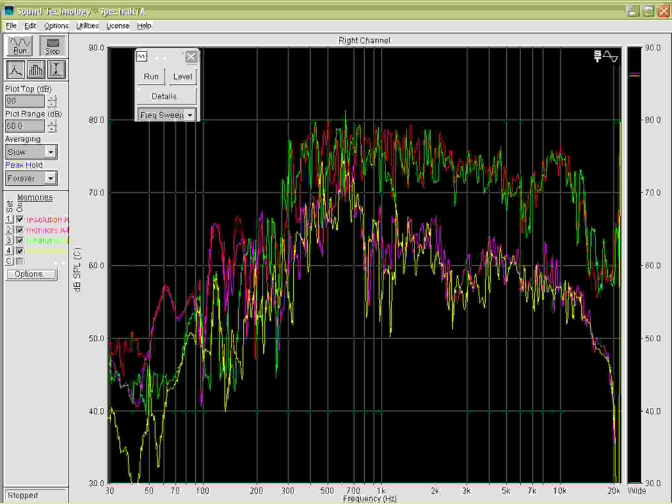
In practice, you will see in the previous 'frequency page' the Arcam and Pioneer ampd had no signifficant difference, playing sweeps, although they diverge at the bass end, and the differences may be due to pre
-amplifier design variations.. The red/green curves are resolution loudspeakers played from Arcamand pioneer A400 amps resp., the purple/yellow are Celestion SL6 loudspeakers (inefficient requiring the more powerful
A400?) shows this is hardly any better off for the bigger amp .
Certainly the amplifier introduces an extra component-variation in F.R., but it is more likely the effect is interactive with the loudspeaker(due to), than if it were driving a pure resistance. Unfortunately I have not yet
tested the output this way, so cannot comment authoritatively.
Cocluding from the test result, we can clearly see that between 70hz and 15khz there is measurably minute differences in F.R between two different amps, so the amplifier is oviosly not affecting the F.R. in general.
I also conducted a test on the NAD 3020e amp I have, comparing the input and output levels, while driving a loudspeaker, and setting up the graph to subtract one from the other - there was a nearly straight line from
above 50hz, indicating virtually no F.R. distortion, even from a budget amp.
Concluding, we can say the amplifier is basically accurate(+- 3db 50-15khz).
|